Two Williamsburg condos can look the same on paper and still be priced thousands apart. If you’ve ever wondered why, you’re not alone. New-development pricing blends land costs, build quality, amenities, taxes, and sponsor strategy into one number: price per square foot. In this guide, you’ll learn how that number is set, how to decode premiums and concessions, and how to calculate your true effective price so you can compare buildings with confidence. Let’s dive in.
Price per square foot basics
Price per square foot, or PPSF, is the headline metric for new condos. It reflects what the developer paid for the site, what it cost to build, and what nearby projects are getting. In Williamsburg, PPSF can shift block to block based on subway access, zoning, and even whether a site has river or corner exposure. You’ll see sponsors test pricing to match buyer demand and keep sales moving at a steady pace.
Land and site specifics
Land cost per buildable square foot is a core driver. In Williamsburg, sites closer to the L, J/M/Z, or G lines, near ferry terminals, or with through-block or corner exposure typically carry a higher basis. Zoning also matters, since R6, R7, and R8 districts allow different density and impact project economics. Those inputs show up in the PPSF you see.
Construction, soft costs and financing
Construction in NYC is expensive, and design choices can add to it. Complex foundations, glass facades, or cantilevers raise unit costs and push PPSF higher. Soft costs like architecture, permits, insurance, and loan interest also factor in. When rates are higher, sponsors often need stronger pricing or more targeted concessions to meet lender and profit targets.
Unit mix, absorption and comps
A building’s mix of 1 to 3 bedrooms, plus duplexes and penthouses, influences average PPSF. Larger, well-laid-out units often command stronger prices. Sponsors also track new-development and resale comps nearby. In strong markets, new product can trade above resale; in softer periods, pricing may meet or undercut resale to maintain absorption.
Adjustments that move PPSF
Not all square footage is equal. Certain features push pricing up or down compared with a building’s average.
Amenities and services
Full-service buildings with concierge, fitness centers, roof decks, lounges, and playrooms tend to trade at a higher PPSF than boutique buildings with limited amenities. The exact uplift varies with quality and scale. Remember, you pay in two ways: an upfront price premium and higher ongoing common charges to operate those amenities.
Floor, views and outdoor space
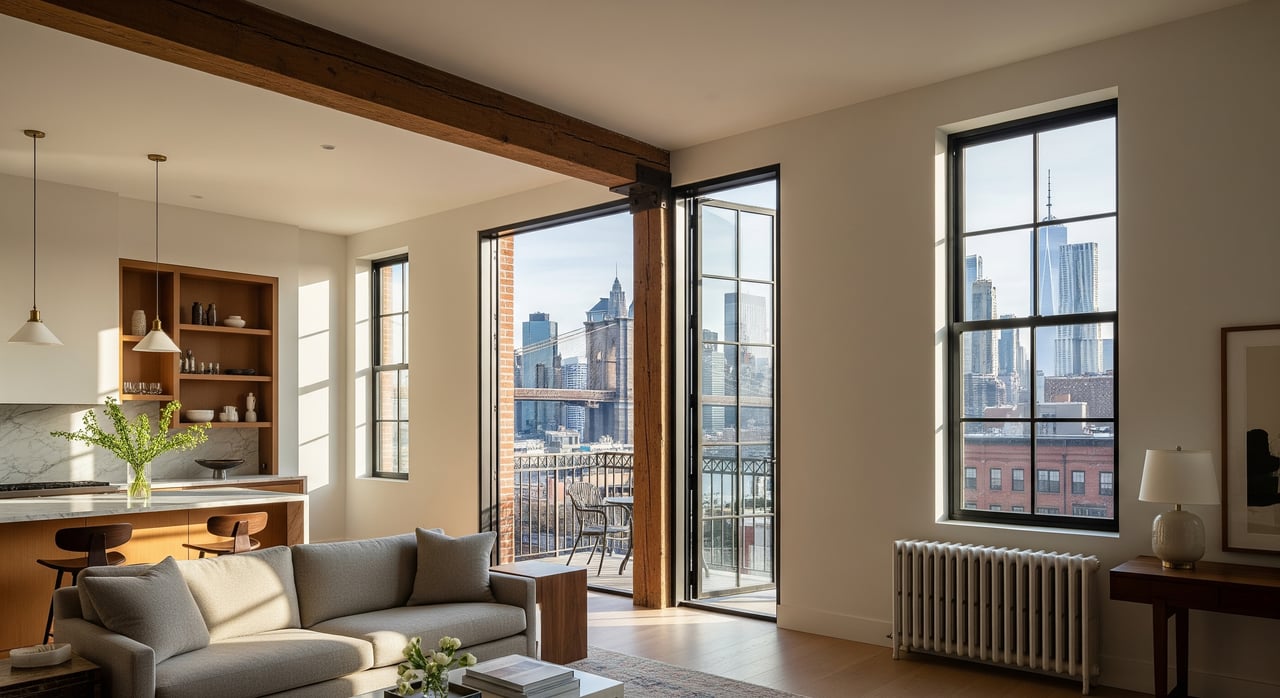
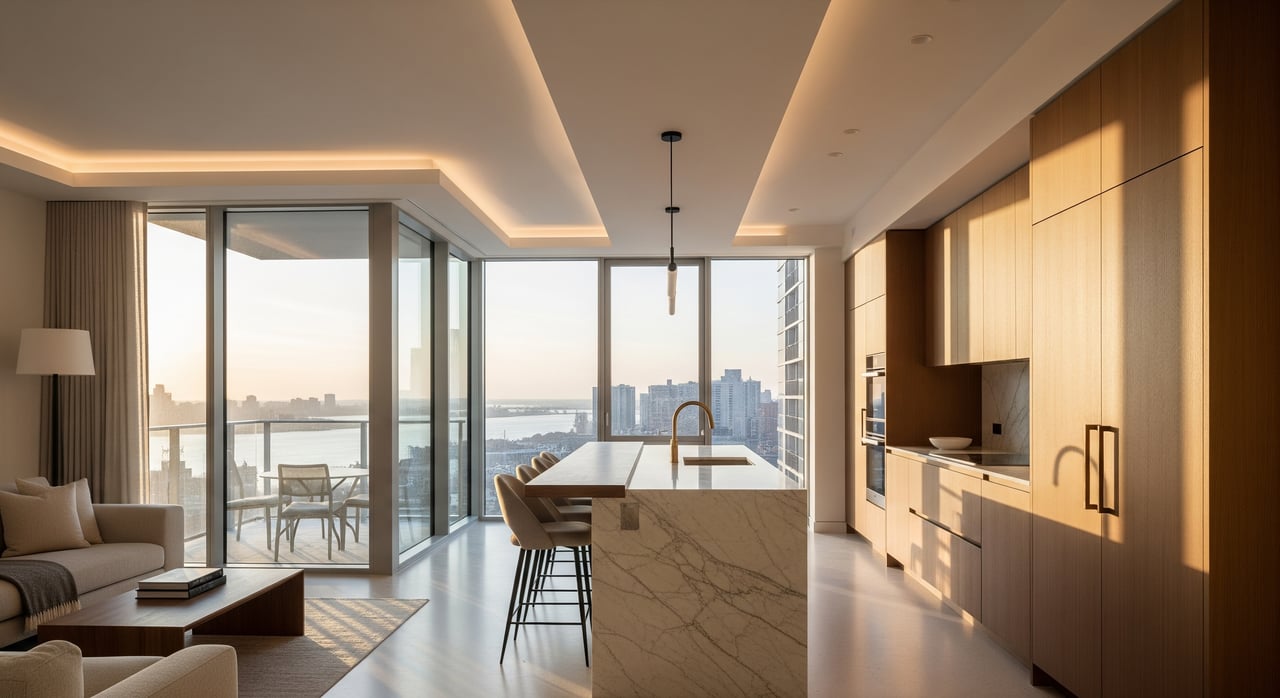
Higher floors typically see step-ups in PPSF, especially when sight lines improve or outdoor space enters the mix. In Williamsburg, East River or Manhattan skyline views are a meaningful premium compared with interior or street-facing exposures. Corner lines, wrap terraces, and floor-through layouts usually sit at the top of a building’s pricing stack.
Layout, ceilings and finishes
Efficient layouts with minimal hallway space, higher ceiling heights, and well-chosen finishes support stronger PPSF. Appliance packages, stone selections, wood flooring, and integrated HVAC all feed into sponsor pricing. Two apartments with the same square footage can price very differently if one is more efficient and better appointed.
Boutique vs full-service buildings
Boutique properties often offer lower common charges and a more intimate scale, which some buyers prefer. Their PPSF can be lower, though in certain micro-markets scarcity can create premiums. Sponsors of smaller projects may negotiate more on price or timing to hit sales milestones. Full-service buildings deliver convenience and lifestyle, reflected in higher PPSF and operating budgets. Larger, institutional sponsors sometimes favor targeted concessions over across-the-board price cuts.
Advertised vs effective price
The list price tells only part of the story. Concessions, taxes, and common charges can change your true cost.
Translate concessions into price-equivalent
Concessions come in many forms. Convert each one into a dollar-per-square-foot reduction so you can compare apples to apples.
- Closing credit or price reduction:
- Price-equivalent reduction ($/sf) = total concession ÷ unit square footage.
- Example: A $20,000 credit on an 800 sf unit equals a $25/sf effective reduction.
- Free months of common charges:
- Total subsidy = months free × monthly common charge.
- Price-equivalent reduction ($/sf) = total subsidy ÷ unit square footage.
- Example: 6 free months × $600/mo = $3,600; on 800 sf, that’s about $4.50/sf.
- Interest rate buy-downs or sponsor financing:
- Estimate the present value of interest savings over the benefit period and divide by unit square footage to get a $/sf reduction.
Important note: A closing-cost credit reduces your cash due at closing but may not lower your mortgage principal if your loan is based on the contract price. Clarify treatment with your lender.
Model tax abatements and carrying cost
Many Williamsburg projects have benefited from tax exemptions or abatements under programs administered over the years. Abatement status varies by building and vintage, so confirm the details for each property. A multi-year exemption can materially reduce early-year carrying costs and may be priced in by the sponsor or presented as a selling point.
Use this simple approach:
- Identify projected annual property tax with and without the abatement from sponsor materials.
- Add common charges to get total annual carrying cost.
- Divide by unit square footage to get $/sf/year for carrying cost.
- If the sponsor offers a common-charge subsidy, annualize and subtract that benefit to see the net.
Effective annual cost per square foot
To compare two units as an owner-occupier, look at the effective annual cost per square foot.
- Effective annual carrying cost = annual property tax + annual common charges minus any annualized concession benefit.
- Effective annual cost per sf = effective annual carrying cost ÷ unit square footage.
For investors, add rental income, realistic operating expenses, and the expected exit to evaluate return.
Investor lens: modeling your exit
If you plan to rent and later sell, build a simple model. Start with your acquisition price per square foot after concessions. Layer in expected rent per square foot, a vacancy assumption, common charges, taxes after any abatement phases down, and maintenance items. Then estimate an exit PPSF based on nearby resales and apply selling costs to see your net.
Common valuation views include a comparable-sales approach for likely resale PPSF and an income-capitalization view for rental strategy using a target cap rate. Run sensitivities on rent growth, exit PPSF, and carrying costs so you understand your break-even points.
Market signals to watch in Williamsburg include absorption rates for new developments and resales, the new supply pipeline from permit and CO filings, and rental vacancy and rent growth. Local infrastructure and retail shifts can influence longer-term values.
Due diligence and verification
Going from list price to a smart offer requires documents and checks. Ask for and review the following:
Documents to request
- Sponsor offering plan with stated unit square footage, PPSF, projected taxes, and the schedule of common charges.
- Any tax abatement or exemption details, including start date, step-down schedule, and expiration.
- Recent comparable sales used by the sponsor to support pricing.
- Amenity operating budget and capital reserve plan.
- Written list of concessions and how they are delivered, such as price credits, closing credits, or allowances.
Questions to ask on site
- What do common charges include and how are amenity costs allocated?
- Are any amenities separately metered or fee-based?
- What is the expected certificate of occupancy timeline and abatement activation date?
- Are there planned nearby developments that could affect light or views?
- What flexibility exists on price, upgrades, or closing timing?
Where to verify data
Confirm property tax, abatement status, recorded sales, permits, and CO milestones with primary sources. Useful references include the NYC Department of Finance for property taxes and abatement records, the NYC Department of Buildings for permits and certificate of occupancy status, and NYC ACRIS for recorded deeds and sales history. Sponsor offering plans and attorney disclosures are the primary project documents.
Smart negotiating in this market
Timing and unit selection matter. Early in a building’s sales cycle, sponsors often prioritize velocity and may offer stronger concessions. Units with interior exposures, lower floors, or less efficient layouts can be priced to move. In larger full-service projects, you might see package incentives like closing credits, upgrades, or temporary common-charge subsidies rather than broad price cuts. Translate everything to a $/sf impact and compare to nearby comps before you offer.
Putting it all together
When you compare Williamsburg condos, look beyond the headline PPSF. Adjust for floor, view, layout, amenities, concessions, and taxes. Then convert everything into an effective price and an annual carrying cost per square foot. That framework gives you a clean way to compare a boutique walk-up near the L train with an amenity-rich tower with river views.
If you want a second set of eyes, we can help you benchmark comps, analyze abatement terms, and translate concessions into a clear price-equivalent so you buy with confidence. Connect with Donald Lai to start a focused search and get a clear plan for your next move in Williamsburg.
FAQs
How are new-development condos priced in Williamsburg?
- Sponsors set list PPSF based on land and build costs, soft costs and financing, unit mix, and nearby new-development and resale comps, then adjust for views, floor, layout, and amenities.
What is an amenity premium in Williamsburg condos?
- Amenity-rich buildings often trade at higher PPSF and carry higher common charges, but the size of the premium varies by quality and scope; benchmark against nearby projects to gauge the uplift.
How do tax abatements change my monthly cost?
- A multi-year exemption lowers early property taxes, which reduces carrying cost; confirm start date, step-down schedule, and expiration to understand the long-term impact.
How should I value a sponsor concession?
- Convert each concession to a $/sf reduction: divide a price or closing credit by unit square footage, and for free common charges, multiply the months by the monthly charge and divide by square footage.
How do I compare boutique and full-service buildings?
- Compare net effective price after concessions, projected carrying cost, and your preference for services; investors should also model rental income, expenses, and likely exit PPSF.
Are concessions a sign the unit is overpriced?
- Not necessarily; sponsors use concessions to drive absorption or ease closing costs without changing list price, so translate the offer to a $/sf impact and compare to comps before judging value.